Thursday, May 14, 2020

H13-211 Training Material - HCIA-Intelligent Computing V1.0

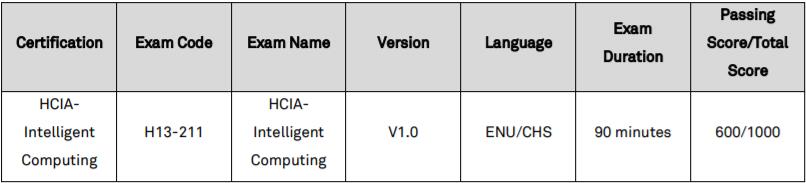
H13-211 Huawei Certified ICT Associate-Intelligent Computing exam is available at PassQuestion. New Released H13-211 Training Material provided by PassQuestion would be the finest and most successful method to prepare for the HCIA-Intelligent Computing V1.0 H13-211 exam. Real H13-211 questions and answers are fully prepared for you to participate in the H13-211 HCIA-Intelligent Computing V1.0 exam.

HCIA-Intelligent Computing V1.0 Certification Exam

The HCIA-Intelligent Computing V1.0 certification aims to enable engineers with basic knowledge and skills in the intelligent computing field, including computing industry basis, chip technology, computing system architecture and products etc.
The HCIA-Intelligent Computing V1.0 curriculum includes a brief history and development trend of the computing industry, an overview of the computing system architecture, a Computing platform and common technologies, as well as industry solution cases.
Passing the HCIA-Intelligent Computing V1.0 certification will indicate that you have the basic knowledge about the intelligent computing industry, software and hardware architecture of the computing system, common technologies of servers and chips and application practices in typical industry solutions. You will have the knowledge and skills required for intelligent computing pre-sales technical support, intelligent computing after-sales technical support, intelligent computing product sales, intelligent computing project management, server engineers and data center IT engineers.
Enterprises who employ HCIA-Intelligent Computing V1.0 certified engineers will be able to implement basic design, operation and maintenance of intelligent computing products and solutions to meet the challenges of the intelligent computing era.
H13-211 Exam Content - HCIA-Intelligent Computing V1.0

The HCIA-Intelligent Computing exam includes: Brief History and Development Trend of the Computing Industry, Overview of the Computing System Architecture, Introduction to Computing Platform Products, Common Technologies and O&M of the Computing Platform and Industry Solution Cases.

1. Brief History and Development Trend of the Computing Industry 10%

Brief History and Development Trend of the Computing Industry
Classification and Features of Processor Chips
Definition and Characteristics of Heterogeneous Computing

2. Overview of the Computing System Architecture 20%

Definition of the Computing System
Product type of computing system
Introduction to mainstream players in the computing system

3. Introduction to Computing Platform Products 30%

Server Type and Software and Hardware Structure
Key Components of the Server
Introduction to Computing Product Software

4. Common Technologies and O&M of the Computing Platform 30%

Computing platform HA technology (including cluster and stateless computing)
Technologies Related to Heterogeneous Computing and Intelligent Acceleration
Intelligent Operation & Maintenance of computing products (server management software and Ansible foundation)

5. Industry Solution Cases 10%

HPC solution (including the TaiShan HPC solution)
Artificial intelligence and intelligent edge solution.
View Online H13-211 Free Questions From PassQuestion HCIA-Intelligent Computing V1.0 H13-211 Training Material

1. The history of robots is not long. In 1959, the United States Ingeber and Dvor made the first generation of industrial robots in the world, and the history of robots really began.
According to the development process of the robot, it is usually divided into three generations, what are respectively? (Multiple choice)
A. Intelligent robot
B. Teaching reproducible robot
C. Robot with a sense
D. Thinking robot
Answer: ABC
2. What subject is artificial intelligence?
A. Mathematics and physiology
B. Psychology and physiology
C. Linguistics
D. Comprehensive cross-cutting and marginal disciplines
Answer: D
3. Description of artificial intelligence: Artificial intelligence is a new technical science that studies, develops the theories, methods and application systems for simulating, extending and expanding human intelligence, and is one of the core research areas of machine learning.
A. True
B. False
Answer: A
4. When was the first time to propose "artificial intelligence"?
A. 1946
B. 1960
C. 1916
D. 1956
Answer: D
5. Dark Blue "Human-Machine War" In May 1997, the final computer of the famous "Human-Machine War" defeated the world chess king Kasparov with a total score of 3.5 to 2.5. What is this computer called?
A. Navy
B. Dark green
C. Thinking
D. Blue sky
Answer: A
6. In which year did Huawei formally provide services as a cloud service, and cooperate with more partners to provide richer artificial intelligence practices?
A. 2002
B. 2013
C. 2015
D. 2017
Answer: D

AWS Certified Solutions Architect – Professional Dumps

AWS Certified Solutions Architect – Professional is a hot AWS Certification exam pursuing by lots of people. In order to help you pass this AWS Certified Solutions Architect – Professional exam, PassQuestion offers the latest and valid AWS Certified Solutions Architect – Professional Dumps which contain most up-to-date questions with correct answers to help you achieve success, we ensure 100% passing in your first attempt.

AWS Certified Solutions Architect – Professional Certification Exam

The AWS Certified Solutions Architect – Professional exam is intended for individuals who perform a solutions architect role with two or more years of hands-on experience managing and operating systems on AWS. We recommend that individuals have two or more years of hands-on experience designing and deploying cloud architecture on AWS before taking this exam.
Abilities Validated by the Certification
Design and deploy dynamically scalable, highly available, fault-tolerant, and reliable applications on AWS
Select appropriate AWS services to design and deploy an application based on given requirements
Migrate complex, multi-tier applications on AWS
Design and deploy enterprise-wide scalable operations on AWS
Implement cost-control strategies

Exam Details

Format: Multiple choice, multiple answer
Type: Professional
Delivery Method: Testing center or online proctored exam
Time: 180 minutes to complete the exam
Cost: 300 USD (Practice Exam: 40 USD)
Language: Available in English, Japanese, Korean, and Simplified Chinese

AWS Certified Solutions Architect – Professional Exam Content

View Online AWS Certified Solutions Architect – Professional Free Questions

1.Your company policies require encryption of sensitive data at rest. You are considering the possible options for protecting data while storing it at rest on an EBS data volume, attached to an EC2 instance.
Which of these options would allow you to encrypt your data at rest? (Choose 3)
A. Implement third party volume encryption tools
B. Implement SSL/TLS for all services running on the server
C. Encrypt data inside your applications before storing it on EBS
D. Encrypt data using native data encryption drivers at the file system level
E. Do nothing as EBS volumes are encrypted by default
Answer: ACD
2.A customer is deploying an SSL enabled web application to AWS and would like to implement a separation of roles between the EC2 service administrators that are entitled to login to instances as well as making API calls and the security officers who will maintain and have exclusive access to the application’s X.509 certificate that contains the private key.
A. Upload the certificate on an S3 bucket owned by the security officers and accessible only by EC2 Role of the web servers.
B. Configure the web servers to retrieve the certificate upon boot from an CloudHSM is managed by the security officers.
C. Configure system permissions on the web servers to restrict access to the certificate only to the authority security officers
D. Configure IAM policies authorizing access to the certificate store only to the security officers and terminate SSL on an ELB.
Answer: D
3.You have recently joined a startup company building sensors to measure street noise and air quality in urban areas. The company has been running a pilot deployment of around 100 sensors for 3 months each sensor uploads 1KB of sensor data every minute to a backend hosted on AWS. During the pilot, you measured a peak or 10 IOPS on the database, and you stored an average of 3GB of sensor data per month in the database. The current deployment consists of a load-balanced auto scaled Ingestion layer using EC2 instances and a PostgreSQL RDS database with 500GB standard storage. The pilot is considered a success and your CEO has managed to get the attention or some potential investors. The business plan requires a deployment of at least 100K sensors which needs to be supported by the backend. You also need to store sensor data for at least two years to be able to compare year over year Improvements. To secure funding, you have to make sure that the platform meets these requirements and leaves room for further scaling.
Which setup win meet the requirements?
A. Add an SQS queue to the ingestion layer to buffer writes to the RDS instance
B. Ingest data into a DynamoDB table and move old data to a Redshift cluster
C. Replace the RDS instance with a 6 node Redshift cluster with 96TB of storage
D. Keep the current architecture but upgrade RDS storage to 3TB and 10K provisioned IOPS
Answer: C
4.A web company is looking to implement an intrusion detection and prevention system into their deployed VPC. This platform should have the ability to scale to thousands of instances running inside of the VPC.
How should they architect their solution to achieve these goals?
A. Configure an instance with monitoring software and the elastic network interface (ENI) set to promiscuous mode packet sniffing to see an traffic across the VPC.
B. Create a second VPC and route all traffic from the primary application VPC through the second VPC where the scalable virtualized IDS/IPS platform resides.
C. Configure servers running in the VPC using the host-based 'route' commands to send all traffic through the platform to a scalable virtualized IDS/IPS.
D. Configure each host with an agent that collects all network traffic and sends that traffic to the IDS/IPS platform for inspection.
Answer: D
5.A company is storing data on Amazon Simple Storage Service (S3). The company's security policy mandates that data is encrypted at rest.
Which of the following methods can achieve this? (Choose 3)
A. Use Amazon S3 server-side encryption with AWS Key Management Service managed keys.
B. Use Amazon S3 server-side encryption with customer-provided keys.
C. Use Amazon S3 server-side encryption with EC2 key pair.
D. Use Amazon S3 bucket policies to restrict access to the data at rest.
E. Encrypt the data on the client-side before ingesting to Amazon S3 using their own master key.
F. Use SSL to encrypt the data while in transit to Amazon S3.
Answer: ABE
6.Your firm has uploaded a large amount of aerial image data to S3. In the past, in your on-premises environment, you used a dedicated group of servers to oaten process this data and used Rabbit MQ - An open source messaging system to get job information to the servers. Once processed the data would go to tape and be shipped offsite. Your manager told you to stay with the current design, and leverage AWS archival storage and messaging services to minimize cost.
Which is correct?
A. Use SQS for passing job messages use Cloud Watch alarms to terminate EC2 worker instances when they become idle. Once data is processed, change the storage class of the S3 objects to Reduced Redundancy Storage.
B. Setup Auto-Scaled workers triggered by queue depth that use spot instances to process messages in SOS Once data is processed, change the storage class of the S3 objects to Reduced Redundancy Storage.
C. Setup Auto-Scaled workers triggered by queue depth that use spot instances to process messages in SQS Once data is processed, change the storage class of the S3 objects to Glacier.
D. Use SNS to pass job messages use Cloud Watch alarms to terminate spot worker instances when they become idle. Once data is processed, change the storage class of the S3 object to Glacier.
Answer: C

Wednesday, April 29, 2020

Microsoft MB-700 Exam Questions

MB-700 exam is a new Microsoft exam related to Microsoft Certified: Dynamics 365: Finance and Operations Apps Solution Architect Expert certification.The Microsoft MB-700 Exam Questions of PassQuestion can not only help you pass Microsoft Dynamics 365: Finance and Operations Apps Solution Architect exam successfully and consolidate your professional knowledge, but also provide you one year free update service.

MB-700 Exam Overview - Microsoft Dynamics 365: Finance and Operations Apps Solution Architect (beta)

The new Microsoft Certified: Dynamics 365: Finance and Operations Apps Solution Architect Expert certification has one exam that is currently in beta: MB-700: Microsoft Dynamics 365: Finance and Operations Apps Solution Architect. You must also have either the Microsoft Certified: Dynamics 365: Finance and Operations Apps Developer Associate or any Microsoft Certified: Dynamics 365 Finance and Operations Functional Consultant Associate certification.
Solution Architects for Finance and Operations apps in Microsoft Dynamics 365 are trusted advisors who consult with organizations and implementation team members to refine business needs into a well-defined and cost-effective solution.

Microsoft MB-700 Exam Skills Measured

Identify solution requirements (30-35%)
Design solution components (40-45%)
Define solution testing and management strategies (25-30%)

Prerequisites:

Complete one of the following certifications:
Microsoft Certified: Dynamics 365 Finance Functional Consultant Associate(MB-300 MB-310)
Microsoft Certified: Dynamics 365 Supply Chain Management, Manufacturing Functional Consultant Associate(MB-300 MB-320)
Microsoft Certified: Dynamics 365 Supply Chain Management Functional Consultant Associate(MB-300 MB-330)
Microsoft Certified: Dynamics 365: Finance and Operations Apps Developer Associate(MB-300 MB-500)

View MB-700 Free Questions From PassQuestion Microsoft Dynamics 365 MB-700 Real Questions

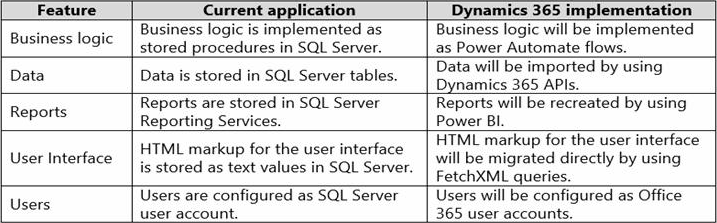
1.A company uses a legacy finance application that runs on a single SQL Server instance. The company plans to implement Dynamics 365 Finance. 
The following table describes the current implementation and design decisions for the new implementation:
You need to identify the gap in the migration plan.
Which requirement should you identify as a gap?

A. Business logic
B. Users
C. User Interface
D. Reports
E. Data
Answer: B
2.A company use Dynamics 365 Business Central.
The company identifies the following issues:
- Users report they cannot perform planning and dispatching of service orders or track bills of material in the system.
- The finance department says that licensing costs are higher than budgeted.
You need to recommend a solution to address the issues.
What should you recommend?

A. Use the Lifecycle Services business process modeler to create service order management and manufacturing tasks in the BPM Library.
B. Perform a fit-gap analysis. Implement service order management and manufacturing business processes and license changes.
C. Configure all users as Business Central Premium users.
D. Ensure that the service order management and manufacturing processes steps are documented in a flow chart.
E. Configure all users as Business Central Essentials users.
Answer: B
3.A holding company with three independently managed and operated subsidiaries is implementing Dynamics 365 Finance.
The company needs to ensure the restriction of data for each company from subsidiary counterparts.
You need to determine an organization structure.
Which structure should you recommend?

A. single legal entity with security policies
B. separate legal entities
C. single legal entity with custom business unit financial dimension
D. single entity that consolidates legal entities
E. single legal entity with default business unit financial dimension
Answer: B
4.A company plans to implement Dynamics 365 Finance + Operations (on-premises). The company has system compliance requirements that must be addressed. You need to design the solution for the company.
What should you address in the design?

A. employee retirement
B. data privacy
C. fair labor standards
D. equal employment opportunity
Answer: B
5.An organization is implementing Dynamics 365 Finance.
The organization uses financial reports including detailed balance information in local currencies for all accounts. Reports must include general ledger account number and journal entry line description. You need to recommend a report that meets the requirements.
Which report should you recommend?

A. Audit Details
B. Summary Trial Balance
C. Balance Sheet
D. Cash Flow 
Answer: A
6.A trading company is concerned about the impact of General Data Protection Regulation (GDPR) on their business. The company needs to define personal data for their business purposes.
You need to define personal data as defined by GDPR.
Which three types of data are considered personal data? Each correct answer presents a complete solution. NOTE: Each correct selection is worth one point.

A. password
B. Social Security number
C. a portion of the address (region, street, postcode etc.)
D. International article (EAN) number
E. MAC address
Answer: ABC

Oracle Autonomous Database 1Z0-931 Questions

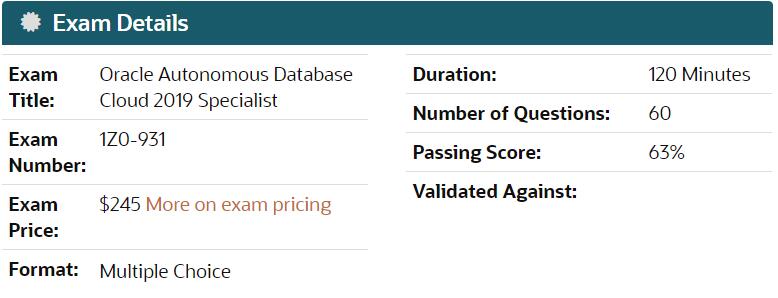
1Z0-931 Oracle Autonomous Database Cloud 2019 Specialist exam is a hot Oracle Certification test. PassQuestion provides Oracle Autonomous Database 1Z0-931 Dumps to help you validate the knowledge and skills to pass Oracle 1Z0-931 exam. You will be well prepared for Oracle 1Z0-931 exam and then successfully pass the 1Z0-931 Oracle Autonomous Database Cloud 2019 Specialist exam.

1Z0-931 Exam Overview - Oracle Autonomous Database Cloud 2019 Specialist

Oracle Autonomous Database Cloud Specialist is a must have certificates for any IT professional working with any cloud technologies.An Oracle Autonomous Database 2019 Specialist has demonstrated the knowledge required to provision, manage, and migrate to Autonomous Transaction Database (ATP) and Autonomous Data Warehouse (ADW).  It is designed for database administrators, monitors, and Dev Ops admins who want to validate their knowledge and skills. 
 
Individuals who earn this certification are able to understand the features and workflows of  Autonomous Database; provisioning and connecting, migration using SQL Developer, Data Pump and Golden Gate, manage and monitor, and understand tools, reporting and analytics using Autonomous Data Warehouse. 

1Z0-931 Exam Topics Covered In Oracle Autonomous Database Cloud 2019 Specialist

Autonomous Database Technical Overview
Migration and Data Loading into Autonomous Database
Monitoring Autonomous Database
Provisioning and Connectivity
Managing and Maintaining Autonomous Database
Tools, Reporting and Analytics using Autonomous Data Warehouse (ADW)

View Oracle Autonomous Database 1Z0-931 Free Questions

1.What are two advantages of using Data Pump to migrate your Oracle Databases to Autonomous Database? (Choose two.)
A. Data Pump can exclude migration of objects like indexes and materialized views that are not needed by Autonomous Database.
B. Data Pump is platform independent - it can migrate Oracle Databases running on any platform.
C. Data Pump is faster to migrate database than using RMAN.
D. Data Pump creates the tablespaces used by your Autonomous Database.
Answer: AC
2.The default eight-day retention period for Autonomous Database performance data can be modified using which DBMS_WORKLOAD_REPOSITORY subprogram procedure?
A. UPDATE_OBJECT_INFO
B. MODIFY_SNAPSHOT_SETTINGS
C. CREATE_BASELINE_TEMPLATE
D. MODIFY_BASELINE_WINDOW_SIZE
Answer: B
3.Which task is NOT automatically performed by the Oracle Autonomous Database?
A. Backing up the database.
B. Mask your sensitive data.
C. Patching the database.
D. Automatically optimize the workload.
Answer: B
4.Which three statements are true about procedures in the DBMS_CLOUD package? (Choose three.)
A. The DBMS_CLOUD.PUT_OBJECT procedure copies a file from Cloud Object Storage to the Autonomous Data Warehouse.
B. The DBMS_CLOUD.CREATE_CREDENTIAL procedure stores Cloud Object Storage credentials in the Autonomous Data Warehouse database.
C. The DBMS_CLOUD.VALIDATE_EXTERNAL_TABLE procedure validates the source files for an external table, generates log information, and stores the rows that do not match the format options specified for the external table in a badfile table on Autonomous Data Warehouse.
D. The DBMS_CLOUD.DELETE_FILE procedure removes the credentials file from the Autonomous Data Warehouse database.
E. The DBMS_CLOUD.CREATE_EXTERNAL_TABLE procedure creates an external table on files in the cloud. You can run queries on external data from the Autonomous Data Warehouse.
Answer: BDE
5.Which of these database features is NOT part of the Autonomous Database?
A. Online Indexing
B. Flashback Database
C. Real Application Clusters (RAC)
D. Java in the Database
Answer: D
6.Which two statements are true with regards to Oracle Data Sync? (Choose two.)
A. Data Sync can connect to any jdbc compatible source like MongoDB, RedShift and Sybase.
B. Data Sync can use a normal OCI (thick) client connection to connect to an Oracle database.
C. Data Sync can load your data in parallel in order to speed up the loading process.
D. Data Sync has default drivers available that supported loading data from DB2, Microsoft SQL Server, MySQL and Teradata.
Answer: AC

Monday, April 27, 2020

PSM II Exam Questions - Professional Scrum Master II

Want to pass PSM II Professional Scrum Master II Exam? Using PassQuestion PSM II Exam Questions can help you pass the Professional Scrum Master II exam easily. If you are the first time to participate in Scrum PSM II exam, selecting PassQuestion PSM II Exam Questions will increase your confidence of passing the exam and will effectively help you pass the PSM II exam.

PSM II Exam Overview - Professional Scrum Master II

The Professional Scrum Master level II (PSM II) assessment is available to anyone who wishes to demonstrate his or her ability to apply the Scrum framework to solving advanced, complex problems in the real world. Those that pass the assessment will receive the industry recognized PSM II Certification as an indication of their advanced knowledge and abilities pertaining to Scrum and the role of the Scrum Master.

Professional Scrum Master II Exam Details

Fee: $250 USD
Passing score: 85%
Time limit: 90 minutes
Number of Questions: 30 (partial credit provide on some questions)
Difficulty: Advanced
Format:  Multiple Choice, Multiple Answer and True/False
Language: English only

PSM II Professional Scrum Master II Exam Subject Areas

Scrum Framework
Scrum Theory and Principles
Teams
Coaching and Facilitation
Done and Undone 
Maximizing Value 
Product Backlog Management
Scaling Fundamentals

The Difference Between PSM I And PSM II Exams

PSM I is perfect for people who want to understand the basics of Scrum thoroughly. The training and study required prior to the assessment make sure that you are comfortable using internationally recognized terminology for Scrum approaches.
PSM II is the next step for people who want to take it further. It goes beyond being able to evidence that you understand Scrum, and shows that you can use it in the workplace.
PSM I is a prerequisite for taking the PSM II assessment. The second Professional Scrum Master level builds on what is assessed at Level 1, so you need to have successfully taken and passed the PSM I assessment before moving on to the PSM II exam.

View Professional Scrum Master II PSM II Free Questions

1.A Scrum Master is not only a servant-leader to the Scrum Team and organization, it's also considered a management position.
Which three activities describe what a Scrum Master manages as reflected by the Scrum Guide? (Choose three.)

A. Reporting on the performance of the Sprint.
B. The way Scrum is understood and enacted within the organization.
C. Managing the capacity and utilization of each Development Team member.
D. Managing the process in which Scrum is applied.
E. Managing the Product Backlog items and work in the Sprint Backlog.
F. Removing organizational impediments that limits the team’s progress and productivity.
Answer: BDF
2.An organization has just hired you as a new Scrum Master to help them transition their teams from their current traditional process to Scrum. The teams are currently structured to specialize in a single function. This is also known as component teams where a team would only address a single layer (i.e. design, frontend, backend, database, testing, etc.). You've introduced the concept of cross-functional teams where all the skills needed to produce business functionality, from end to end, are inside of a single team.
What should you keep in mind when transitioning from siloed teams to cross-functional teams? (Choose two.)

A. It is easier to compare the performance between cross-functional teams in order to identify to which teams to assign tasks and which teams need additional coaching.
B. Newly formed teams will need time to stabilize before reaching their peak performance. During the initial stages of forming, performance will suffer and productivity may be low, although even then delivery of business value is still likely to increase.
C. Without feature teams, you cannot do Scrum. Postpone Scrum adoption until the teams are reorganized in feature teams.
D. People from the different layers and components will need time to become accustomed to working and delivering unified functionality together as one Scrum Team thus productivity may suffer.
Answer: BD
3.Paul is a Product Owner for multiple products. Each product is allocated a dedicated Scrum Team and a set budget. Based on the average velocity of a previous product release, Paul had estimated a new product to take 9 Sprints to complete. The average velocity of the previous product release was 50 completed units of work per Sprint. Over the first 3 Sprints, the Development Team reported an average velocity of 40 completed units per Sprint, while not fully completing the required integration tests. The Development Team estimates that integration testing would require additional effort to make the increments shippable. The Development Team is unsure if the required velocity is achievable.
What is the most effective way to recover?

A. In the next Sprints, the Development Team strives to make the selected work as close to ‘done’ as possible and at the minimum 90% completed. Any undone work is divided into new Product Backlog Items that will be deferred to the last Sprint in order to maintain stable velocity.
B. The Development Team informs Paul that the progress he has perceived to date is not correct. The Increment is not releasable. They give Paul their estimate of the effort it would take to get the previous work ‘done’, and suggest doing that work first before proceeding with new features. The team also re estimates the effort to make the remaining Product Backlog items ‘done’, including all integration effort. In the end, it is Paul’s call to continue the project or to cancel.
C. The Scrum Master will manage the Sprint Backlog and assign work to the Development Team members to ensure maximum utilization of each member. He/she will keep track of unused resources so that it does not impact the budget. Unused budget can be allocated for additional Sprints if needed.
D. The Scrum Master sets the open work aside to be performed in one or more release Sprints. They remind Paul to find funding for enough Release Sprints in which this remaining work can be done. Up to one release Sprint per three development Sprints may be required. It is Paul’s role to inform users and stakeholders of the impact on the release date.
Answer: B
4.Paul, a Product Owner of one of the Scrum Teams, has been attending the Daily Scrum. During the Daily Scrum, the Development Team members have been reporting their daily work to Paul so that he is aware of their Sprint progress and what each member is working on.
What is the best action for the Scrum Master to take?

A. Ask Paul to stop attending the Daily Scrum.
B. Coach Paul and Development Team members on the purpose of the Scrum events and let them figure out what to do in this situation.
C. Allow the Paul to participate in the Daily Scrum as he is responsible for the success of the product.
D. Facilitate the Daily Scrums to avoid any conflicts between the Development Team members and Paul.
Answer: B
5.Steven, the Scrum Master, is approached by one of the Development Team members saying that they are not completing regression tests for all of the work they are performing to the level defined in the Definition of Done. They have discussed this with the Product Owner and decided to remove regression testing from the Definition of Done.
Which two actions are the most appropriate for Steven to take? (Choose two.)

A. Reject the decision as the long term maintainability of the product will be negatively impacted by modifying the Definition of Done.
B. Accept the decision as a mutual agreement has been made between the Development Team and the Product Owner.
C. Ask the Development Team and the Product Owner what problem they are trying to solve by altering the Definition of Done and removing regression testing from it. In what ways will this decision impact transparency and quality?
D. Ask the Development Team and the Product Owner if they are still able to produce potentially shippable product increments by altering the Definition of Done?
Answer: CD

AZ-220 Exam Questions - Microsoft Azure IoT Developer

Microsoft AZ-220 exam is a new exam of Microsoft Azure IoT Developer, if you passed this exam, you will be eligible for the Microsoft Certified: Azure IoT Developer Specialty certification.PassQuestion Microsoft AZ-220 Exam Questions will help you prepare for your AZ-220 exam. It covers the exam objectives and topics you will be tested on. PassQuestion Microsoft AZ-220 testing engine simulates the actual exam experience which can help you pass your AZ-220 exam successfully.

Microsoft Azure IoT Developer AZ-220 Exam Information

This Microsoft Certified Azure IoT Developer AZ-220 will provide you with the skills and knowledge required to successfully create and maintain the cloud and edge portions of an Azure IoT solution. It includes full coverage of the core Azure IoT services such as IoT Hub, Device Provisioning Services, Azure Stream Analytics, Time Series Insights, and more. In addition to the focus on Azure PaaS services, it also includes sections on IoT Edge, device management, monitoring and troubleshooting, security concerns, and Azure IoT Central. 
The Azure IoT Developer is responsible for the implementation and the coding required to create and maintain the cloud and edge portion of an IoT solution. In addition to configuring and maintaining the devices by using cloud services, the IoT Developer also sets up the physical devices. The IoT Developer is responsible for maintaining the devices throughout the life cycle.

AZ-220 Exam Skill Measured - Microsoft Azure IoT Developer

Implement the IoT solution infrastructure (15-20%)
Provision and manage devices (20-25%)
Implement Edge (15-20%)
Process and manage data (15-20%)
Monitor, troubleshoot, and optimize IoT solutions (15-20%)
Implement security (15-20%)

View Microsoft Certified: Azure IoT Developer Specialty AZ-220 Free Questions

1. Note: This question is part of a series of questions that present the same scenario. Each question in the series contains a unique solution that might meet the stated goals. Some question sets might have more than one correct solution, while others might not have a correct solution.
After you answer a question in this question, you will NOT be able to return to it. As a result, these questions will not appear in the review screen.
You have an Azure IoT solution that includes an Azure IoT hub, a Device Provisioning Service instance, and 1,000 connected IoT devices.
All the IoT devices are provisioned automatically by using one enrollment group.
You need to temporarily disable the IoT devices from the connecting to the IoT hub.
Solution: From the Device Provisioning Service, you disable the enrollment group, and you disable device entries in the identity registry of the IoT hub to which the IoT devices are provisioned.
Does the solution meet the goal?
A. Yes
B. No
Answer: A
2.Note: This question is part of a series of questions that present the same scenario. Each question in the series contains a unique solution that might meet the stated goals. Some question sets might have more than one correct solution, while others might not have a correct solution.
After you answer a question in this question, you will NOT be able to return to it. As a result, these questions will not appear in the review screen.
You have an Azure IoT solution that includes an Azure IoT hub, a Device Provisioning Service instance, and 1,000 connected IoT devices.
All the IoT devices are provisioned automatically by using one enrollment group.
You need to temporarily disable the IoT devices from the connecting to the IoT hub.
Solution: You delete the enrollment group from the Device Provisioning Service.
Does the solution meet the goal?
A. Yes
B. No
Answer: B
3.You plan to deploy a standard tier Azure IoT hub.
You need to perform an over-the-air (OTA) update on devices that will connect to the IoT hub by using scheduled jobs.
What should you use?
A. a device-to-cloud message
B. the device twin reported properties
C. a cloud-to-device message
D. a direct method
Answer: D
4.You have an IoT device that gathers data in a CSV file named Sensors.csv. You deploy an Azure IoT hub that is accessible at ContosoHub.azure-devices.net. You need to ensure that Sensors.csv is uploaded to the IoT hub.
Which two actions should you perform? Each correct answer presents part of the solution. NOTE: Each correct selection is worth one point.
A. Upload Sensors.csv by using the IoT Hub REST API.
B. From the Azure subscription, select the IoT hub, select Message routing, and then configure a route to storage.
C. From the Azure subscription, select the IoT hub, select File upload, and then configure a storage container.
D. Configure the device to use a GET request to ContosoHub.azure-devices.net/devices/ContosoDevice1/ files/notifications.
Answer: AC
5.You plan to deploy an Azure IoT hub.
The IoT hub must support the following:
- Three Azure IoT Edge devices
- 2,500 IoT devices
Each IoT device will spend a 6 KB message every five seconds.
You need to size the IoT hub to support the devices. The solution must minimize costs.
What should you choose?
A. one unit of the S1 tier
B. one unit of the B2 tier
C. one unit of the B1 tier
D. one unit of the S3 tier
Answer: D

Saturday, April 25, 2020

Cisco 350-801 CLCOR Exam Questions

Preparing for 350-801 Implementing and Operating Cisco Collaboration Core Technologies(CLCOR) Exam? PassQuestion provides you not only with the best Cisco 350-801 CLCOR Exam Questions and also with excellent service.PassQuestion provides a clear and superior solutions for each candidates.Through Cisco 350-801 CLCOR Exam Questions provided by PassQuestion, we can ensure you have a successful challenge when you are the first time to participate in the CCNP Collaboration certification 350-801 exam.

350-801 CLCOR Exam Overview - New CCNP Collaboration Certification Core Exam

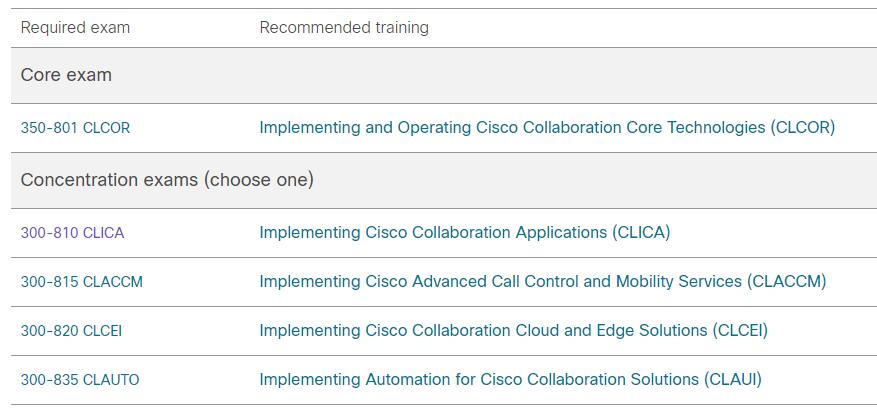
Achieving CCNP Collaboration certification proves your skills with collaboration solutions. To earn CCNP Collaboration certification, you pass two exams: one that covers core collaboration technologies and one collaboration concentration exam of your choice, so you can customize your certification to your technical area of focus.
The Implementing Cisco Collaboration Core Technologies v1.0 (CLCOR 350-801) exam is a 120-minute exam associated with the CCNP Collaboration, CCIE Collaboration, and Cisco Certified Specialist - Collaboration Core certifications. This exam tests a candidate's knowledge of implementing core collaboration technologies including infrastructure and design, protocols, codecs, and endpoints, Cisco IOS XE gateway and media resources, Call Control, QoS, and collaboration applications.

350-801 CLCOR Exam Topics Covered In CCNP Collaboration 350-801 Real Test

This exam tests your knowledge of implementing core collaboration technologies, including:
Infrastructure and design
Protocols, codecs, and endpoints
Cisco IOS XE gateway and media resources
Call Control
QoS
Collaboration applications

View Online Cisco CCNP Collaboration Core Exam 350-801 CLCOR Free Questions

1.Which action is required if an engineer wants to have Cisco Unified Communications Manager configuration for an MGCP gateway?
A. Upload the custom configuration in the TFTP server in cisco Unified CM.
B. Configure the Cisco Unified CM's IP in voice service VoIP.
C. Apply the ccm-manager configuration commands to the gateway.
D. From Cisco Unified CM >Device > Gateway > Add gateway, check the auto-configuration check box.
Answer: C
2.Which two functionalities does Cisco Expressway provide in the Cisco collaboration architecture? (Choose two.)
A. Survivable Remote site Telephony functionality
B. Secure firewall and NAT traversal for mobile or remote Cisco Jabber and TelePresence video endpoints
C. Customer interaction management services
D. Secure business-to-business communications
E. MGCP gateway registration
Answer: BD
3.Which Cisco Unified Communications Manager service parameter should be enabled to disconnect a multiparty call when the call initiator hangs up?
A. Block OffNet to OffNet Transfer
B. Drop Ad Hoc Conference
C. H.225 Block Setup destination
D. Enterprise Feature Access code for conference
Answer: B
4.How many DNS SRV entries can be defined in the SIP trunk destination address field in Cisco Unified Communications Manager?
A. 4
B. 1
C. 8
D. 16
Answer: B
5.Which description of the function of call handlers in Cisco Unity Connection is true?
A. They control outgoing calls by allowing you to specify the numbers that Cisco Unity Connection can dial to transfer calls, notify users of massages, and delivery faxes.
B. They collect information from callers by playing a series of questions and recording the answers.
C. They answer calls, take message, and provide menus of options.
D. They provide access to a corporate directory by playing an audio list that users and outside callers users and leave messages.
Answer: C
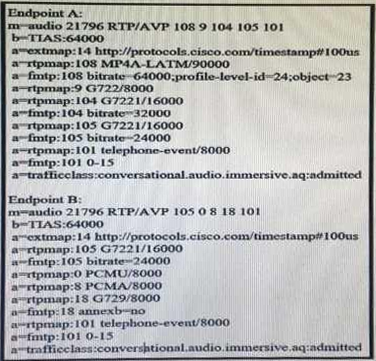
6.Refer to the exhibit.
Endpoint A calls endpoint B.
What is the only audio codec that can be used for the call?

A. G277/8000
B. PCMA/8000
C. Telephone-event/8000
D. G7221/16000
Answer: A